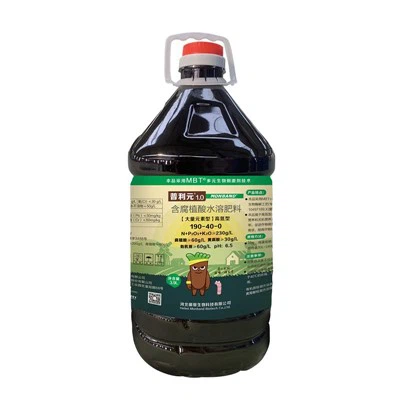
As a supplier of Humic Acid Liquid Fertilizer, I often encounter questions from customers regarding the particle size of humic acid in our liquid fertilizers. Understanding the particle size is crucial as it directly impacts the effectiveness and application of the fertilizer. In this blog post, I'll delve into the details of the particle size of humic acid in liquid fertilizers, its significance, and how it relates to our products.
The Basics of Humic Acid in Liquid Fertilizers
Humic acid is a complex mixture of organic compounds that are formed through the decomposition of plant and animal matter over time. It is a key component in many fertilizers due to its ability to improve soil structure, enhance nutrient availability, and promote plant growth. When incorporated into liquid fertilizers, humic acid offers several advantages, including easy application and rapid absorption by plants.
In a liquid fertilizer, humic acid exists in a colloidal state. Colloids are particles that are larger than individual molecules but smaller than what can be seen with the naked eye. These particles are dispersed throughout the liquid medium, creating a stable suspension. The particle size of humic acid in liquid fertilizers can vary depending on several factors, such as the source of the humic acid, the extraction process, and the formulation of the fertilizer.
Factors Affecting the Particle Size of Humic Acid
Source of Humic Acid
The source of humic acid plays a significant role in determining its particle size. Humic acid can be derived from various sources, including leonardite, peat, and lignite. Each source has its own unique chemical composition and physical properties, which can influence the size of the humic acid particles. For example, humic acid extracted from leonardite tends to have a more uniform particle size compared to that from peat, as leonardite is a more highly decomposed material.
Extraction Process
The method used to extract humic acid from its source also affects the particle size. Different extraction techniques can break down the humic acid into different-sized particles. For instance, alkaline extraction methods are commonly used to isolate humic acid from organic materials. These methods can result in a range of particle sizes, depending on the concentration of the alkaline solution, the extraction time, and the temperature. Some extraction processes may also involve additional steps, such as filtration or centrifugation, which can further refine the particle size.
Fertilizer Formulation
The formulation of the liquid fertilizer can also impact the particle size of humic acid. Other components in the fertilizer, such as nutrients, surfactants, and stabilizers, can interact with the humic acid particles and affect their size and stability. For example, the addition of certain surfactants can help to disperse the humic acid particles more evenly throughout the liquid, preventing them from aggregating and forming larger particles.
Significance of Particle Size in Liquid Fertilizers
Nutrient Availability
The particle size of humic acid in liquid fertilizers can significantly affect nutrient availability to plants. Smaller particles have a larger surface area per unit volume, which means they can interact more effectively with nutrients in the soil. This interaction can help to chelate or bind nutrients, preventing them from being leached away or becoming unavailable to plants. As a result, plants can more easily absorb and utilize the nutrients, leading to improved growth and productivity.
Absorption by Plants
The size of the humic acid particles also influences their ability to be absorbed by plants. Smaller particles can penetrate the plant roots more easily, allowing for faster uptake of nutrients and other beneficial substances. This can enhance the overall efficiency of the fertilizer and improve the plant's response to fertilization. Additionally, smaller particles can also move more freely through the soil pores, reaching a larger area of the root zone and providing more comprehensive coverage.
Stability of the Fertilizer
The particle size of humic acid is important for the stability of the liquid fertilizer. If the particles are too large, they may settle out of the suspension over time, leading to an uneven distribution of the fertilizer. This can result in inconsistent application and reduced effectiveness. On the other hand, if the particles are too small, they may be more prone to aggregation, which can also affect the stability of the fertilizer. Therefore, maintaining an optimal particle size is crucial for ensuring the long-term stability and performance of the liquid fertilizer.
Measuring the Particle Size of Humic Acid
There are several methods available for measuring the particle size of humic acid in liquid fertilizers. One common technique is dynamic light scattering (DLS), which measures the fluctuations in the intensity of light scattered by the particles as they move in the liquid. This method can provide information about the average particle size and the size distribution of the humic acid particles.
Another method is scanning electron microscopy (SEM), which allows for direct visualization of the humic acid particles. SEM can provide detailed information about the shape, size, and surface characteristics of the particles. However, this method is more time-consuming and requires specialized equipment.
Our Approach to Controlling Particle Size
At our company, we are committed to producing high-quality Humic Liquid Fertilizer with optimal particle size. We carefully select the source of our humic acid to ensure a consistent and high-quality raw material. Our extraction process is designed to produce humic acid particles with a narrow size distribution, which helps to maintain the stability and effectiveness of our fertilizers.
We also conduct rigorous quality control measures to monitor the particle size of the humic acid in our products. Using advanced analytical techniques, such as DLS, we ensure that the particle size meets our strict standards. This allows us to provide our customers with a reliable and consistent product that delivers superior results.
Conclusion
The particle size of humic acid in liquid fertilizers is a critical factor that can impact the performance and effectiveness of the fertilizer. By understanding the factors that affect particle size and implementing appropriate control measures, we can produce high-quality liquid fertilizers that provide maximum benefits to plants.


If you are interested in learning more about our Humic Acid Organic Fertilizer or Humic Organic Fertilizer, or if you have any questions about the particle size of humic acid in our products, please feel free to contact us. We are always happy to discuss your specific needs and provide you with the information you need to make an informed decision.
References
- Stevenson, F. J. (1994). Humus Chemistry: Genesis, Composition, Reactions. John Wiley & Sons.
- Hayes, M. H. B., & Swift, R. S. (Eds.). (1990). Humic Substances II: In Search of Structure. John Wiley & Sons.
- Schnitzer, M., & Khan, S. U. (1972). Humic Substances in the Environment. Marcel Dekker.